Organisational decision quality as a strategic strength
We help organisations improve the quality of their decisions through the scientifically grounded development of decision competence and structured support for strategic decision-making.
Transparent, consistent, and robust decisions become a strategic strength for your organisation.
Strategic adjustments, investment decisions, the prioritisation of scarce resources, or conflicts of objectives between profitability and sustainability — decisions determine the long-term ability of organisations to act and compete. They affect management and leadership just as much as specialist roles, teams with responsibility, and employees who make decisions independently in their day-to-day work.
Decisions are regularly made under uncertainty, with incomplete information and differing interests. Domain expertise is a necessary prerequisite for well-founded decisions — but it is not sufficient for high organisational decision quality.
Decision quality emerges when decisions are systematically structured: when it is clear what is being decided and why; when objectives, alternatives, and information are gathered in a structured way; when evaluations are logically and transparently justified; and when decisions are implemented consistently.
Only the interplay of these elements creates high organisational decision quality — and turns it into a strategic strength.
Clear decision question
Decision quality begins with a precisely formulated decision question. It defines:
who is making the decision,
what is being decided,
by when the decision must be made
what scope for action exists.
Only a clearly defined decision situation creates the basis for systematically clarifying objectives and developing meaningful alternatives — instead of jumping too quickly to solutions.
Robust decision frame
Decision quality requires a robust decision frame that systematically connects three elements:
Objectives — What should be achieved in the decision?
Alternatives — What real courses of action are available?
Information — Which assumptions, data and uncertainties are relevant?
The result is a structured and transparent representation of how each alternative performs against the defined objectives.
Coherent decision logic
Decision quality requires coherent and transparent decision logic:
conflicts between objectives are made explicit,
assumptions are disclosed,
uncertainties are systematically taken into account,
evaluations are derived transparently.
The selected alternative follows consistently from the decision frame — rather than from implicit preferences or situational intuition.
Consistent implementation
Decision quality requires committed and reflective implementation:
clear definition of responsibilities,
concrete planning of actions,
systematic review of outcomes,
adaptive adjustment when new information becomes available.
This turns a well-founded decision into effective action — and decision quality into an organisational strength.
Our services for improving organisational decision quality
Organisations face different decision situations: some require the long-term development of competence, while others require the structured clarification of specific, often strategically relevant questions.
In both cases, our work follows the same logic: decision quality emerges when decision questions are precisely formulated, decision frames are robustly designed, evaluations are coherently justified, and decisions are consistently implemented.
We improve organisational decision quality at two levels.
Building organisational decision competence
Our tailored training programmes develop decision competence as a learnable skill — grounded in research and demonstrably effective. Participants learn to systematically structure complex decision situations, clarify objectives, develop courses of action and evaluate them in a well-founded way.
Assumptions and uncertainties are made explicit, and decision-making processes become transparent and understandable. The training programmes are scientifically grounded, practice-oriented and consistently aligned with participants’ real decision situations.
For organisations, managers, leaders and multipliers who want to build decision competence systematically and improve decision quality sustainably — in day-to-day operations as well as in strategic matters.
Structured support for strategic decisions
We advise organisations on specific, complex decision questions as an independent methodological partner. Together, we structure the decision problem, clarify objectives and the decision frame, and make conflicts between objectives and uncertainties explicit. On this basis, we support systematic and transparent decision-making — not by prescribing decisions, but by creating a robust foundation for decision-making.
For executive teams, senior management and decision-relevant roles in strategic, operational or cross-organisational decisions of substantial significance, where clarity, transparency and decision quality under uncertainty are essential.
Scientifically grounded decision-making
Our work combines scientific insights with concrete decisions in organisations. We create clarity about objectives, alternatives and conflicts between objectives, make uncertainties and assumptions explicit, and thereby support decisions that are transparent, robust and well-founded.
Our foundation lies in decision sciences, behavioural economics and problem structuring.
We use established concepts from decision analysis and behavioural economics to make cognitive biases, heuristics and perceptual distortions visible. Building on this, we develop targeted interventions that reduce these distortions and help embed better decision-making habits in everyday organisational practice. This enables people to make decisions in a more structured and deliberate way, even under uncertainty and complexity.
A central focus is the clear definition of objectives, alternatives and causal relationships. To achieve this, we use value-focused thinking — a scientifically grounded approach that has been tested in both research and practice and further developed through our own work. This helps structure the decision space systematically and makes conflicts between objectives transparent — as the basis for robust decisions.
To make the effectiveness of decision competence training measurable, Johannes Siebert developed the Proactive Decision Making Scale — the inspiration behind our name. Studies with more than 4,000 participants in total show that decision competence training leads to lasting improvements in proactive decision-making abilities and is associated with greater self-efficacy and life satisfaction. This evidence informs the design of our programmes.
Johannes Siebert is co-initiator of Entscheidungsnavi, a scientifically grounded decision support tool that makes structured decision-making accessible. The tool illustrates how principles of structured decision-making can be translated into practical formats for clarifying objectives, options, uncertainties and conflicts between objectives.
References, experience and international recognition
The following references, projects and awards provide insight into our work in the field of structured decision-making.
References
Selected references from our collaboration with clients:
The Federal Employment Agency commissioned Proaktiv Entscheiden GmbH to develop a three-day in-person training programme to strengthen decision competence in career counselling. The training is a central element in the qualification and continuous professional development of career counsellors. It specifically addresses how counsellors can support the development of decision competence among the Federal Employment Agency’s clients — as a key competence and future skill in an increasingly complex and volatile world of work and education.
The programme is based on a scientifically grounded concept of decision analysis and combines current scientific insights with strong practical relevance. The train-the-trainer concept developed for this purpose establishes an approach that meaningfully complements and further develops existing counselling practice: career counsellors are strengthened in their role as facilitators of decision processes and provide professional support to people seeking guidance in complex decision situations.
Bundesagentur für Arbeit (Germany’s Federal Employment Agency)
„Proaktiv Entscheiden placed a central content-related focus on decision quality at SUNZINET. The structured approach to designing and evaluating decisions impressed us through its immediate relevance for complex decision-making processes in day-to-day project work and provided important orientation for clarity, alignment and prioritisation. Particularly noteworthy is the consistent linking of the proactive approach with SUNZINET’s central values, which further strengthened its strategic relevance and sustainable impact.“
SUNZINET GmbH, full-service digital agency
Project experience
In addition to the projects conducted by Proaktiv Entscheiden GmbH, our expertise also includes international projects in which the founder has been involved through his long-standing work in the field of decision analysis.
The following projects are examples of his experience in applying structured decision-making methods in strategically demanding decision situations:
Infrastructure & public sector
Supporting the California Department of Transportation in planning and prioritising multi-year budgets for sustainable maintenance programmes.
Pharma & R&D portfolios
Multi-criteria prioritisation and monitoring of compounds under high uncertainty in the early stages of the development pipeline.
The achievements of our founder in the practice-oriented application of scientifically grounded decision analysis and in the promotion of decision quality have received international recognition on multiple occasions.
These awards demonstrate the internationally recognised expertise that shapes our approach at Proaktiv Entscheiden GmbH.
He was awarded the Inspirational Achievement Award by the Society of Decision Professionals (SDP) — an award for formative contributions to decision quality that achieve substantial impact through innovation or implementation, or lead to transformative results or wider application. He has also been a multiple finalist for the Decision Analysis Practice Award of the Institute for Operations Research and the Management Sciences (INFORMS), awarded jointly by the INFORMS Decision Analysis Society and the SDP. The award recognises outstanding practical applications of scientifically grounded decision analysis.
SDP Inspirational Achievement Award
Recognised for developing and scaling practice-oriented training and education programmes to promote decision competence and disseminate a structured approach to improving decision quality.
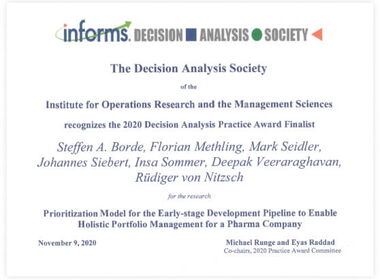
INFORMS Decision Analysis Practice Award Finalist 2020
Finalist for developing a decision-analytically grounded prioritisation model for the holistic management of development portfolios in a pharmaceutical company.
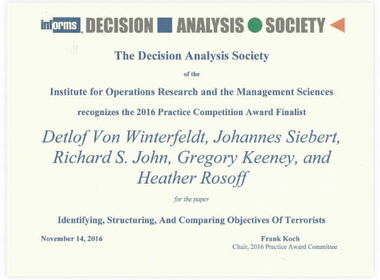
INFORMS Decision Analysis Practice Award Finalist 2016
Finalist for developing and applying a method for identifying and structuring objectives in security-policy decision contexts.
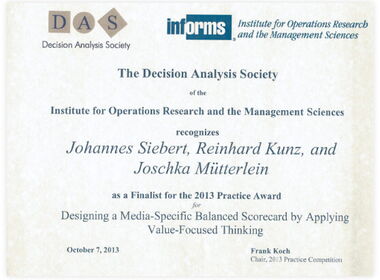
INFORMS Decision Analysis Practice Award Finalist 2013
Finalist for developing a decision-analytically grounded balanced scorecard in the media sector.
Where science meets decision practice
Proaktiv Entscheiden was founded to translate scientific insights into human decision-making consistently into organisational practice.
The starting point for our work is empirical evidence from decision, organisational and behavioural research. We find that decisions rarely fail due to a lack of domain expertise, but rather due to unclear problem structuring, inappropriate methods, cognitive biases and poor decision architectures. This is precisely where our advisory and training work comes in — with the goal of making decisions more transparent, more robust and more effective.
Our work is evidence-based, analytical and methodologically reflective. We use validated models and current research findings with methodological care and practical judgement. Rather than offering standard solutions, we develop tailored decision frameworks that are scientifically grounded, context-sensitive and practically robust.
Jana Siebert
Jana Siebert is a decision scientist and Managing Director of Proaktiv Entscheiden GmbH. She holds a double PhD in Operational Research and Economics and has 12 years of experience in decision research. Her doctoral research on multi-criteria decision models under uncertainty was recognised by the European Society for Fuzzy Logic and Technology (EUSFLAT), an international scientific association. She has also developed methods, tested in empirical studies, that can help reduce the influence of misinformation on real-world decisions.
Johannes Siebert
Johannes Siebert is an award-winning decision researcher, keynote speaker, consultant and founder of Proaktiv Entscheiden GmbH. He has more than 20 years of experience in applied decision research and has led numerous research and consulting projects for organisations in business, politics and the public sector. His work combines scientifically grounded methods with practical application. He developed the Proactive Decision Making Scale and founded the school-based decision education programme KLUG entscheiden!. He also co-developed approaches to problem structuring and co-initiated the decision support tool Entscheidungsnavi.
Let us talk
Are you facing complex decisions or looking to strengthen decision competence sustainably in your organisation?
We would be happy to discuss consulting projects and tailored decision competence training — focused on your specific situation.